
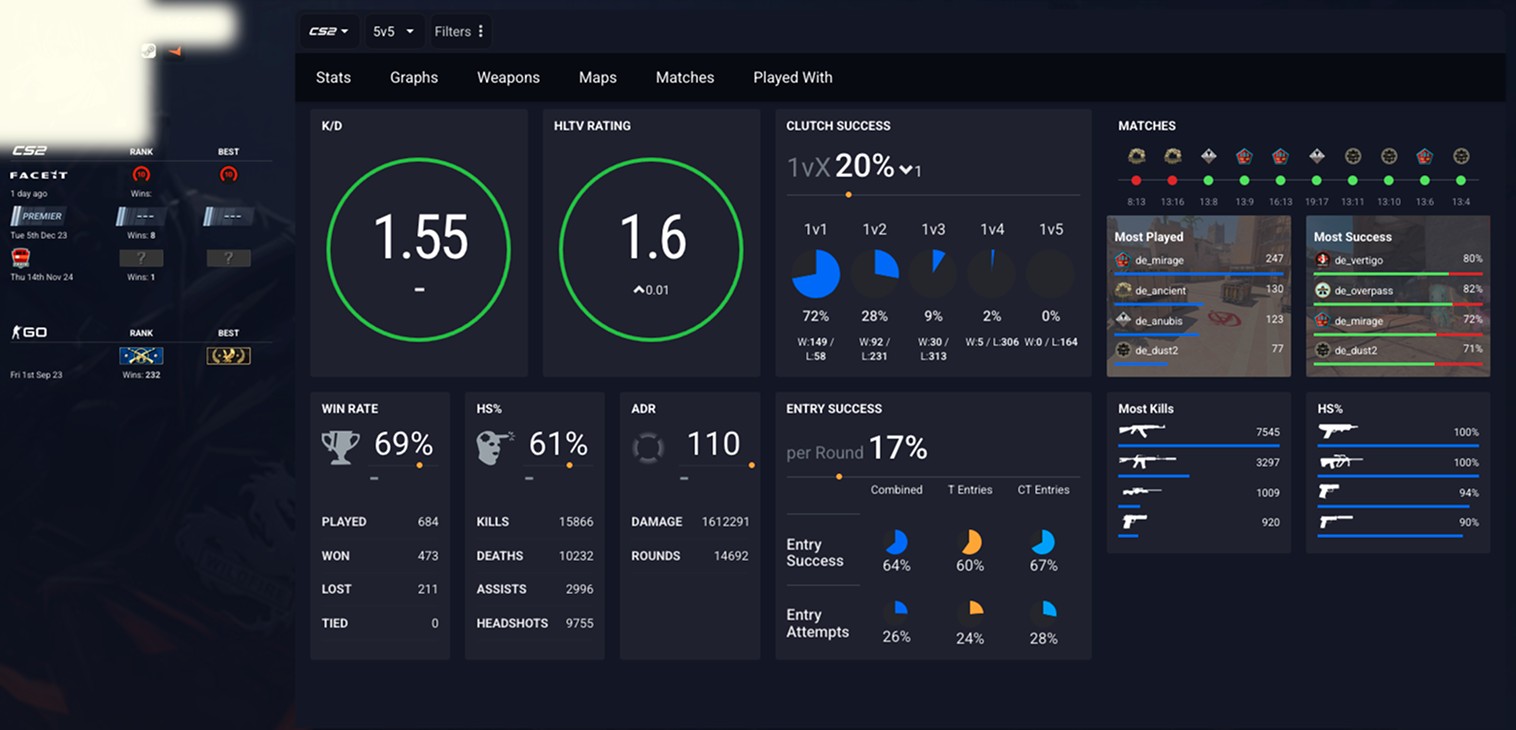
When I think about the future of esports, I increasingly notice the role of data analytics. Competitive games have become so complex and multifaceted that mechanical skills alone are no longer enough for players. Clubs and organizations use data to gain a deeper understanding of their opponents’ style, while players themselves rely on it to improve decision-making during matches. I see this as a major shift: digital metrics are becoming part of strategy rather than just statistics for reporting. What’s also important is that these tools are now available not only to professionals but also to everyday players.
Personal Statistics and Trackers
One of the most noticeable applications of analytics in esports for me has been the services that allow players to track their own performance. In shooters like Valorant, statistics have long gone beyond simple win rate or K/D ratios. Today, players can analyze details such as average damage per round, headshot percentage, first-shot accuracy, or success on specific maps. These metrics provide a much more complete picture of a player’s skill level.
In the past, many relied only on subjective feelings, but now there are tools that turn numbers into a real instrument for growth. In this regard, valorant tracker stands out because it doesn’t just record overall statistics — it highlights both the strengths and weaknesses of a player. For example, you can see how effective pistol rounds are, in which situations duels are most often lost, and where additional training is needed.
In my opinion, this is especially valuable for team play. When each member has access to their own statistical breakdown, it becomes easier to assign roles and build strategies. One player might be stronger at holding positions, another at fast entry duels — and the numbers confirm it. This kind of approach turns analytics into the foundation of team synergy and takes the training process to a higher level.
Analytics as a Weapon for Coaches
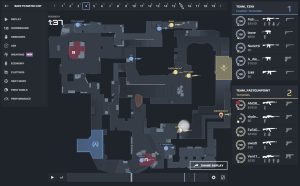
In professional clubs, coaches are increasingly using analytics to prepare for matches. For example, in CS2 or League of Legends they can collect data on opponents’ picks, their favorite strategies, and common mistakes. Once this information is systematized, the team enters the server with prepared scenarios rather than relying only on improvisation. It’s similar to how football clubs build strategies for a specific opponent, but here the volume of data is even greater.
To me, it’s clear that analytics helps coaches reduce the element of randomness. If a team knows that an opponent chooses a certain pick 70% of the time or consistently attacks through the same area of the map, it opens up the chance to prepare countermeasures in advance. In esports the cost of a mistake is very high, and the ability to anticipate such patterns often becomes the decisive factor.
I notice that these methods are bringing esports closer to traditional sports. Tactical preparation is no longer based solely on a coach’s intuition or players’ experience — it is reinforced by large datasets. This makes preparation more precise, while coaches become key figures who transform raw statistics into concrete game plans.
The Use of Big Data by Organizers
Tournament organizers also apply analytics, and this is no less fascinating. At major events, viewers have long been accustomed to seeing not only the score but also entire panels of additional statistics. Economic graphs, heat maps, and real-time win probability make broadcasts richer and more understandable even for those who aren’t deeply immersed in the game.
I believe this has a strong impact on how esports is perceived. When a viewer can follow not just the in-game actions but also the data, they gain a deeper understanding of teams’ strategic decisions. For instance, an economy graph helps explain why a team chooses to play an eco round, while heat maps clearly show which areas of the map remain under control. This creates the feeling of being “inside” the match rather than simply watching from the outside.
Moreover, such tools serve as a marketing instrument. The more engaging a broadcast is, the higher the audience involvement, and therefore the greater the value of esports for sponsors and media. In this sense, big data benefits not only players but the industry as a whole, making it more attractive for new investments.
Prediction and Machine Learning
What fascinates me most is how algorithms are beginning to predict events. Based on millions of played matches, systems can evaluate which strategy in a particular situation will bring the highest chance of victory. This works not only on the level of simple patterns but also by considering context: the heroes chosen, the economic situation, or even the individual style of specific players.
I see enormous potential for training in this. Imagine that after each match a player doesn’t just receive an abstract tip like “you should aim better,” but concrete recommendations: in which rounds they took too many risks, where they failed to use utility, or how their effectiveness changed depending on the role they played. Personalized guidance like this, powered by machine learning, could replace hours of demo reviews.
In addition, such technologies pave the way for new formats of both training and spectator experiences. Algorithms can predict a team’s win probability in real time, making broadcasts even more engaging. For players, it’s also an opportunity to improve faster, since every in-game action becomes a learning signal that the system records and returns as precise feedback.
Conclusion
I am convinced that data analytics is becoming the foundation of competitive gaming. It helps players better understand their strengths and weaknesses, coaches prepare their teams for specific opponents, and organizers make broadcasts more exciting and accessible for the audience. In this way, data permeates every level of the industry and becomes an inseparable part of it.
In the future, the importance of analytics will only continue to grow. Machine learning algorithms, personalized recommendations for players, and match outcome predictions will become standard tools rather than futuristic concepts. Esports is already moving toward greater technological sophistication, and it is data that allows it to become more stable and professional.