
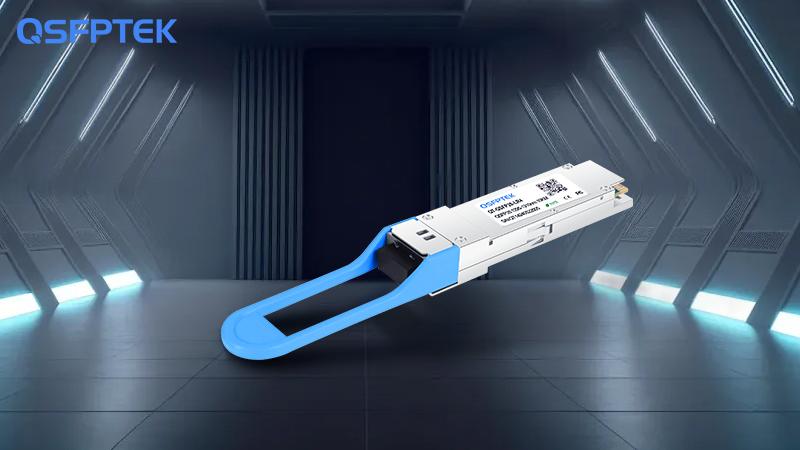
As data centers continue to expand in scale and processing demands, the need for long-reach, stable, and cost-efficient 100G optical connectivity has become more important than ever. Among the numerous 100G optical transceiver types, the 100GBASE-LR4 QSFP28 module stands out as one of the most widely deployed solutions for 10 km single-mode fiber links. Its ability to transmit four wavelengths through a single LC duplex interface makes it ideal for spine-leaf architectures, campus backbones, metro-edge networks, and cloud infrastructure. However, achieving smooth deployment requires a clear understanding of compatibility—both with switches and network interface cards (NICs). This article provides a comprehensive guide to help you ensure compatibility and avoid common integration issues when using 100G QSFP28 LR4 modules.
Understanding the 100GBASE-LR4 QSFP28 Standard
The 100G QSFP28 LR4 module transmits 100G data by combining four 25G optical channels onto four CWDM wavelengths in the 1310 nm window. These wavelengths are multiplexed inside the module and delivered over a single-mode fiber pair via an LC duplex connector. On the receiving side, the module demultiplexes the wavelengths and converts them back into electrical signals. This architecture allows the LR4 standard to support up to 10 km of transmission while maintaining a balance between performance, cost, and energy consumption. Because the technology is standardized under IEEE 802.3ba, LR4 modules from compliant vendors typically maintain broad compatibility across mainstream switches and NICs.
Why Compatibility Matters in 100G Deployments
Even though QSFP28 is a widely accepted form factor, compatibility is not identical across all device manufacturers. Switch vendors implement firmware-level validation mechanisms to ensure network stability and protect system performance. Some vendors enforce strict coding requirements, allowing only approved or vendor-branded modules to operate without warnings. Others offer open compatibility but still require proper coding to guarantee optimal performance. Understanding how your switch or NIC handles QSFP28 modules is the foundation of a successful deployment. Issues such as unrecognized modules, disabled ports, link instability, or DDM misreporting are often rooted in compatibility mismatches rather than hardware defects.
Compatibility Requirements for Switches
Switch Coding and Vendor Lock-In
Most switches use vendor-specific EEPROM coding to identify transceivers. Cisco, Juniper, Arista, HPE, Dell, and other major manufacturers each have their own coding standards, and matching them ensures that the switch reads the module correctly. Some devices strictly enforce this match, while others only display a warning without restricting operation. Ensuring the module is pre-coded to the correct vendor standard eliminates the risk of port shutdowns and operational instability. High-quality third-party vendors often provide multi-vendor coding capabilities, effectively allowing the same module hardware to work across different switch brands after proper re-coding.
Firmware Version Considerations
Switch firmware plays a decisive role in module recognition. As new hardware generations emerge, firmware updates often include changes to transceiver validation rules. A module compatible with an older firmware revision may not be fully recognized after an update. Always verify that the switch firmware version aligns with the compatibility list provided by your module vendor. If a new firmware causes incompatibility, a recoding service or firmware rollback may be required to restore functionality.
Optical Reach and Switch Port Capabilities
Compatibility is not limited to coding. Some switches are designed with specific link budgets and temperature requirements. Because the LR4 module supports 10 km links, its transmit power and receiver sensitivity must match what the switch port expects. Although this is rarely an issue with well-constructed modules, low-quality designs may fail to meet IEEE optical specifications, resulting in marginal links or unexpected alarms. Ensuring your LR4 module meets the standard optical performance parameters is essential for long-distance deployments.
Compatibility Requirements for Network Interface Cards (NICs)
NIC Vendor Coding and System BIOS Interaction
High-speed NICs, such as those from Mellanox NVIDIA, Intel, Broadcom, and Marvell, often rely on even more precise coding requirements than switches. NICs tightly integrate transceiver management with host BIOS, PCIe drivers, and DDM monitoring functions. If the installed module does not match the NIC’s expected coding, the interface may fail to initialize or operate only in degraded mode. Proper coding ensures that the NIC can accurately read parameters such as temperature, voltage, TX/RX power, and fault information, all of which are essential for high-performance computing or cloud workloads.
Signal Integrity and Host Compatibility
NICs are more sensitive to signal integrity because they directly handle server-side data paths. A poorly coded or low-quality module may cause micro-interruptions, link flapping, or performance throttling. To maintain reliable connectivity, select LR4 modules with proven interoperability with server-grade NICs. Confirming the compatibility list with your vendor is especially important in environments that use dual-port or multi-port NICs, where signal interaction is more complex.
How to Ensure Full Compatibility in Your Deployment
Ensuring compatibility involves confirming coding, validating optical performance, matching firmware versions, and verifying that the module supports all DDM parameters. Working with a vendor that provides programmable modules and comprehensive testing across major switch and NIC platforms can significantly reduce risk. For large-scale deployments, requesting a sample module for preliminary testing is an effective strategy. When troubleshooting, always check the switch or NIC logs to determine whether failures stem from coding mismatches, optical issues, or device firmware constraints.
Conclusion
The 100G QSFP28 LR4 optical module remains one of the most versatile and widely adopted long-reach solutions in modern data centers. Its ability to deliver 10 km of stable, single-mode transmission makes it indispensable for core, aggregation, cloud, and backbone networks. However, achieving seamless performance requires more than selecting the correct form factor. Switches and NICs impose different coding, firmware, and validation requirements that directly influence module functionality. By understanding these compatibility factors and choosing properly coded, standards-compliant modules, network operators can ensure smooth integration and reliable 100G performance. A well-planned compatibility strategy not only reduces deployment risks but also protects network stability and lowers maintenance costs across the lifecycle of the infrastructure.