
Graffiti Storytelling: Using AI Design to Visualize Emotions, Lyrics, and Protest Art
Graffiti has never been anything but a voice for the voiceless — a concrete diary spewing on a wall, screaming truth, rhythm, and revolution. From the wall of a subway train to the edge of an imaginary canvas, its intention is constant: to convey what mere words cannot. But what occurs when technology enters this artistic pandemonium? With resources such as Pippit’s online graffiti generator, artists, musicians, and digital narrators are now able to turn sentiments, words, and social causes into vibrant color works of art. The walls might be virtual, but the passion is all authentic.
Pippit is where raw energy meets innovation; it’s a studio for creators who want to see their art scream. Whether you’re picturing the sadness of a song, painting the message of a protest, or shaping your own personal mantra, Pippit can help you translate that feeling into stunning graffiti visuals that are bold, layered, and full of life.
Colors that carry emotion: painting feelings through pixels
Every color has a narrative. In graffiti, colors are not merely ornamentation — they are emotional languages. Reds seethe with rage or passion, blues moan sorrow, and neon green flashes hope or irony. With computer-based graffiti, that color palette becomes infinitely malleable. Artists may now toy with saturation, texture, and gradient until the image seems like the feeling it is attempting to convey.
Picture a musician putting out a new single — a rough, lyrical admission. Rather than a plain album cover, they create a graffiti poster that’s full of jagged pinks and darkened purples, representing the pull between disorder and exposure. Pippit makes that translation of emotion into shape happen in an instant. What used to take spray cans and a wall can now exist on screens, shirts, or even lyric vids.
Digital rebellion: protest art in the age of pixels
Graffiti has always been a protest against silence, conformity, or injustice. But with the digital age, protest no longer requires permission or place; it requires intention. Activists are using digital graffiti to call out their movements in bold clarity — abstract fists, broken faces, or signs that appear to have been ripped off the streets.
That’s where Pippit comes in. Rather than using complicated software or real murals, activists can create, edit, and send graffiti graphics that encapsulate their mission in mere seconds. In a combination of color and form, a single design can convey solidarity, emergency, or defiance — and spread on the web quicker than a drop of paint on an urban wall.
At other times, artists consciously reduce the resolution of their images through the use of Pippit’s low quality image maker, imparting digital protest art with the gritty texture of real street tags. That intentional flaw brings a sense of authenticity — a reminder that rebellion in pixels should look handmade, human, and alive.
Lyrical graffiti: imagining music and rhythm
For artists, graffiti is a reflection of sound — creating color equivalents of beats and lyrics. Every splash, swirl, and crack replicates rhythm. A slow R&B song could become gentle pastel sprays, and a punk anthem could burst into angular lettering and wild bursts of color.
Pippit’s software allows artists to connect their aural realm to their visual one. A line of sorrow can bleed into a crimson haze; a stanza of hope could glow with golden filaments. Visual poets and indie bands are particularly attracted to this — their work isn’t just in words or sound, but in the visual feeling those forms create. Art has this hidden pulse. It’s like a heartbeat built out of pixels and colors.
From emotion to shape. Making graffiti art using Pippit
You want to turn your ideas or words, or feelings into graffiti that really gets the point across. Pippit lets you do that. It helps create art that’s bold and full of expression. Stuff that packs the real strength of what you’re trying to say. Here’s how:
Step 1: Choose “Poster” from Image Studio
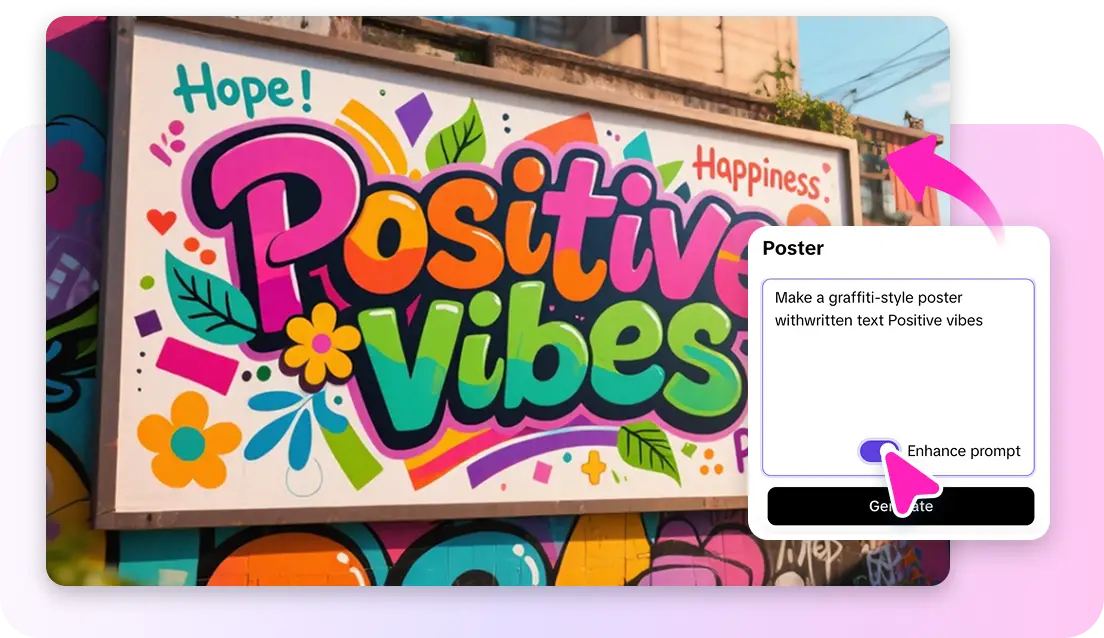
When you’re ready to create your design, click on Image Studio from Pippit’s left panel and click on AI Design to open your creative space. This is where your journey into graffiti-inspired fashion begins. It could be a chaotic logo for a hoodie, a vibrant back print for a jacket, or maybe your design includes a graffiti-style slogan on the side of a shoe — this is your virtual wall.
Step 2: Insert your idea and generate
In the prompt box, type out your idea: maybe something like “electric graffiti logo with neon drips and abstract street tags.” Switch Enhance prompt on to get to polish detail, plus graffiti would be your style, select your poster type (product or creative), then hit Generate. Pippit will translate your idea into several graffiti artworks in seconds, all ready for apparel printing.
Step 3: Select, personalize, and finalize your design
Once all of your designs have been generated, scan through and select the design that is most you. Click it to open on the canvas, and once opened, you can edit the text, colors, or criticism of it. You can add to the depth of the background or whatever site to emphasize your tag name. Yup, you are now ready to finalize your design by clicking Download. You have just created digital graffiti that can be compiled for printing on your next streetwear drop.
The emergence of visual poets and hybrid creators
People keep talking about this fresh wave of artists popping up. They mix up different mediums like its no big deal. You know, they might write some poetry that ends up as graffiti on a wall. Or they could turn graffiti into a kind of video setup for a spoken word performance. These folks hang out in that weird in-between space. Its between text and images, or feelings and straight-up expression.
AI graffiti design software such as Pippit gives these hybrid makers the ability to express themselves in multiple dimensions. Rather than having to decide whether to be writer, artist, or activist, they get to be all of them — employing color and form to convey stories that speak across senses and mediums.
Color as protest, shape as emotion
Each line of graffiti is an act of resistance — against sameness, against quiet. And yet, beyond resistance, it’s also a matter of connection. When you imagine your feelings, you’re allowing others to glimpse bits of their own reflected back. That’s why digital graffiti narrative is so compelling. It converts individual emotion into communal resonance.
With Pippit, you are able to harness that energy to project your cause, song, or poem — making intangible emotions visually unforgettable.
A last spray: from pixels to passion with Pippit
In this era of online storytelling, graffiti no longer remains on the walls of cities — it flourishes on screens, on merchandise, and through movements. With Pippit, the ability to convey emotion through graffiti is now accessible to all. Musicians can bring rhythm to life, activists can bring voices into the mainstream, and dreamers can bring moods to murals.
If you’re ready to give your art some real life. To make that message hit people both in the eyes and in the gut. Just open up Pippit. Go ahead and kick off your first graffiti design right now. The canvas stretches out forever. Your story sits there. Waiting for you to spray it out.